
Every year, between the first cold snap of autumn and the deep frosts of winter, the same sequence unfolds on pig farms across the northern hemisphere. A cough appears in one barn, then another. Nursery pigs go off feed and huddle under heat lamps that suddenly seem inadequate. A finishing group that looked uniform two weeks ago begins to spread out in body weight, and by the time the veterinarian is called, mortality has started. Producers describe the pattern as clockwork. Yet what arrives "on schedule" is not a single pathogen and not bad luck, but a predictable convergence of climate, building physics, pathogen ecology, and the management calendar — a convergence veterinary science calls porcine respiratory disease complex.
The Cost of a Season That Never Fails to Arrive
Swine respiratory disease is the largest chronic drain on pork production economics. Research from Iowa State University led by Dr. Derald Holtkamp estimated that PRRS — the viral cornerstone of most respiratory complexes — caused $1.2 billion per year in lost production in the U.S. pork industry from 2016 to 2020, up sharply from the $664 million estimated for 2006 to 2010. That rise was not driven by prices or herd size; the disease itself has become more damaging, and four decades of experience have not reversed the trend. Behind that headline sits a quieter cost centre: Mycoplasma hyopneumoniae, the agent of enzootic pneumonia, has been estimated to be present in 93% of swine herds globally. A pathogen that widespread does not announce itself with dramatic outbreaks. It simply ensures that many herds never quite reach the performance their genetics and feed should deliver.
The First Mechanism: Thermal Shock, Not Cold Itself
Pigs are poorly equipped for thermal fluctuation: limited functional sweat glands, a thin layer of subcutaneous fat in modern genotypes, and a narrow thermoneutral zone. What makes autumn dangerous is instability rather than cold — a wide swing between afternoon warmth and night-time chill leaves the animal never fully acclimatised to either. Below the thermoneutral zone, the pig must increase metabolic heat production, and that energy is drawn from growth, reproduction, and immune defence. Simultaneously, the stress response mobilises glucocorticoids and catecholamines, suppressing immune competence and shifting blood flow away from mucosal tissues. This explains what every producer has observed: a cold snap passes, and several days later the outbreak begins. The insult is rarely the cold itself, but what the cold does to the immune system in the days that follow.
The Second Mechanism: The Ventilation Paradox
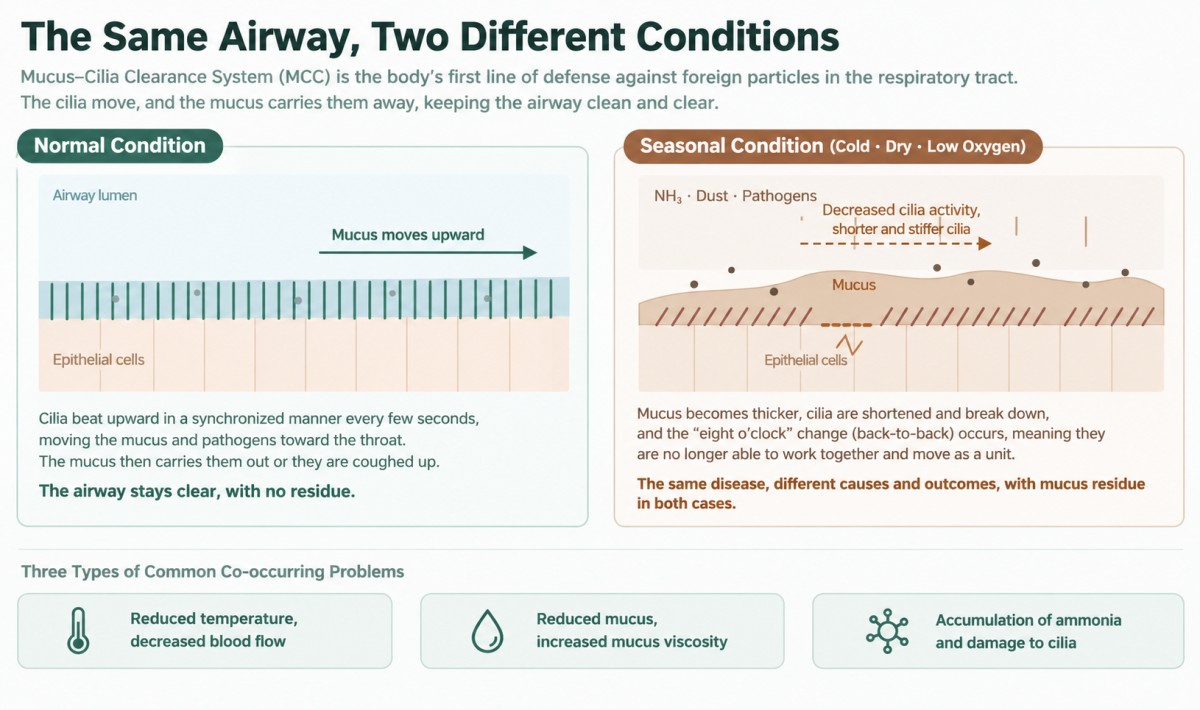
The response to falling temperatures is instinctive: close the building and keep the heat in. But the purpose of pig house ventilation is not only temperature control. It exists to remove moisture, ammonia, hydrogen sulfide, dust, and airborne microorganisms — and sealing a barn to conserve heat allows all of them to accumulate. Elevated ammonia in pig barns directly damages the respiratory epithelium and impairs mucociliary clearance, the cilia-driven escalator that forms the pig's first line of defence. Dust carries bacteria and endotoxin deep into the lower lung, while high humidity prolongs pathogen survival; PRRSV in particular persists well in cold, humid conditions and on equipment that remains wet. The very act of protecting pigs from the cold therefore creates the environment in which respiratory pathogens thrive. Winter ventilation is a continuous balancing act between thermal comfort and air quality, and getting it wrong in either direction produces the same clinical outcome by different routes.
The Third Mechanism: An Ecology Built for Co-Infection
None of this would matter as much if the organisms involved were not so well adapted to exploit a compromised airway. Mycoplasma hyopneumoniae colonises the ciliated epithelium of the trachea and bronchi and destroys the apparatus that clears inhaled debris. Its signature lesion is lung consolidation, and studies in finishing pigs show consolidation carries measurably negative consequences for productive performance and economic revenue. What makes the organism genuinely dangerous is its role as a facilitator: by dismantling the mucociliary escalator it opens the lower respiratory tract to secondary invaders such as Pasteurella multocida, Streptococcus suis, and viruses including PRRSV and swine influenza. This is the "complex" in PRDC. Each pathogen alone may cause modest, subclinical losses; combined, they produce the severe, chronic pneumonia that producers recognise only once it is embedded in a barn.
The Fourth Mechanism: A Calendar That Clusters Risk
Autumn is also when management events cluster: gilts arrive and are acclimatised, groups are mixed to fill barns, weaning batches are consolidated, vaccination schedules come due, and ventilation shifts to winter mode. Each is simultaneously a stress event and a mixing event, and mixing is the most reliable way to amplify pathogen circulation. A gilt carrying a strain to which the sow herd has partial immunity, placed beside pigs whose immunity is waning, in a building whose air exchange has just been cut, is the textbook setup for an outbreak. Autumn is not intrinsically more pathogenic than spring. It is more crowded with risk, and the risks arrive together.
Why Fighting Fires in December Is Always Too Late
By the time coughing is audible across a barn, substantial lung tissue has often been compromised and days of gain have been lost that will never be recovered. Antibiotics address secondary bacterial infection; they cannot reverse consolidation, restore destroyed cilia, or compensate for poor air quality. The room to rely on antimicrobials is also narrowing under residue and resistance pressure in most major markets, which makes prevention commercially necessary rather than merely preferable. The respiratory season must be prepared for in early autumn, not treated in midwinter — and producers who begin the cold months with clean air, stable groups, and completed immunity experience the same weather as their neighbours and a fraction of the disease.
Building Resilience: Air, Immunity, and Nutrition
The environmental fundamentals carry the highest return of any intervention in a seasonal respiratory programme. Verify that actual ventilation rates match controller settings, set minimum ventilation to remove moisture and ammonia without chilling the animals, and measure air quality at pig level rather than trusting the human nose, which fatigues quickly and under-reports. Keep lying areas dry, avoid drafts on young stock, and check temperatures at animal height and at night, when the swing occurs and staffing is thinnest. Immunity must then be built before the challenge: complete vaccination and acclimatisation ahead of the season, reduce mixing wherever possible, and keep weaning age consistent.
Nutrition deserves equal weight, because respiratory defence is metabolically expensive and because cold stress and immune activation both raise oxidative load. This is where phytogenic feed additives for pigs have earned increasing attention. Reviews of plant-derived additives in swine report improvements in growth performance, nutrient digestibility, gut microbiota, and immune response, with benefits most evident under disease or stress conditions — precisely the autumn scenario. Essential oils from cinnamon, oregano, and thyme have shown potential as phytogenic additives in swine nutrition, and plant extracts have been reported to reduce the adverse effects of PRRSV by improving piglet immune responses.
How Agovee Supports Respiratory Resilience Through the Cold Season
This is the ground on which AGOVEE has built its range of natural feed additives for pigs. Rather than substituting nutrition for good management, Agovee products reinforce the physiological foundations on which management depends: immune competence, mucosal integrity, antioxidant capacity, and the efficiency with which a challenged animal converts feed into gain. The company's pig immune support formulations deliver plant-derived polysaccharides, flavonoids, and polyphenols that support both innate and adaptive immunity, helping animals maintain responsiveness to vaccination when stress hormones are working against them. Complementary natural respiratory support for pigs draws on aromatic plant compounds, including oregano-derived essential oils, that support mucosal integrity in the airway and normal clearance function — protecting the first line of defence before pathogens reach the lower lung.
Because the inflammatory cascade is central to PRDC pathology, Agovee's formulations also target oxidative and inflammatory burden. A multi-compound antioxidant network built on natural vitamin E, selenium, and plant polyphenols helps neutralise reactive oxygen species, protect epithelial tissue, and support recovery after stress events, while gut health components support intestinal barrier integrity and a balanced microbiota — significant because a substantial share of immune capacity resides in the gut. On the performance side, Agovee supports feed conversion efficiency and growth uniformity during and after respiratory challenge, which is where the economics of a season are ultimately decided. All Agovee pig products are 100% natural, antibiotic-free, and residue-free, with no withdrawal periods, making them compatible with export, premium, and antibiotic-free pork production programmes.
The Season Will Arrive. The Outbreak Does Not Have To.
Nothing about this is mysterious. Cold air, sealed buildings, a pathogen ecology built for co-infection, and a calendar that concentrates mixing into eight weeks will produce the same result every year, in every production system — from large integrated operations in China, the United States, Brazil, Spain, Germany, Denmark, the Netherlands, and Poland to commercial farms in Vietnam, the Philippines, Thailand, India, Mexico, and Canada, and growing pig enterprises across Nigeria, Kenya, South Africa, Ghana, Uganda, and Tanzania. What can change is the herd's starting position when the season begins. Agovee partners with producers, integrators, feed mills, and veterinarians worldwide to deliver science-backed natural nutrition for respiratory resilience and herd performance. Contact Agovee today to build a cold-season respiratory programme — protect lung health, hold your feed efficiency, and stop paying for a season you already knew was coming.
Please give us a message